Last weekend, Lawna and I drove up to Frankfurt in a rented black VW van to pick up our son Michael and his girlfriend, Victoria, at the city bus terminal where they arrived from a stay in Berlin. Michael is working on his doctorate in German at Columbia University and is making an annual visit to brush up on the language in country. After waiting for some time, a bit anxiously since they do not have cell phone service during their stay in Europe, I finally caught sight of a fully bearded Michael and then Victoria in a long yellow dress, both wheeling their bikes from the bus they had deboarded. It was wonderful to see them! Michael studied at Goethe University in Frankfurt a few years ago and knows the town. We stowed the bikes and their backpacks in the rented van, and then Michael guided us through the city metro system to the picturesque historic center of an otherwise modern high rise city, and, after walking around the town square and taking some pictures, we found an Italian restaurant and enjoyed a leisurely meal with good conversation. I think we helped to close the restaurant, and, as we still had a two hour drive back to Spesbach, we hopped back onto the metro, made our way back to the van which was safely parked by the bahnhof (train station), and started off home.
Together in Frankfurt
It has been just Lawna and I these last months since we arrived in Germany, and it is good to have the company now of our son and Victoria. Lawna grew up with two brothers and later had two sons. In other words, she has lived her life in a high testosterone environment, and I think the extended company of Victoria has been a real joy for her. They have gone clothes shopping together, and walked out into the nearby fields to pick summer flowers and make arrangements for the apartment. Victoria is like the daughter or sister she never had. It has been fun just to watch movies together in the evening, passing a bowl of popcorn around.
Michael atop Homburg Schloss
Michael and I have biked around the Spesbach and Landstuhl area together, and the four of us have climbed up to the castle ruins of Homburg, and then enjoyed beers together down at the base of the hill. Later in the week we drove to Strasbourg to see the cathedral and wander around the shops and cafés. Finally, this last weekend, we drove south to Freiburg, where Michael first lived in Germany on his study abroad program. I booked hotel rooms so that we could make a full weekend of the visit, and, again, Michael, visibly happy to be back in his first German city, showed us around his old hood. We saw the great Münster cathedral, a vast Teutonic gothic structure full of bizarre medieval carvings. Michael and Victoria climbed the tower stairs to the viewing area while Lawna and I rested our feet below in the cooler vault of the church (the temperature had reached the humid nineties, and Germany has almost no air conditioning). Now I kind of wish I had made the climb. Maybe next cathedral--they're everywhere here.
in Strasbourg
Staying cool in Freiburg
Freiburg bikes
Freiburg türm
Market flower stand
Münster tower
Münster Tannhäuserish interior
Freiburg street clown
On Thursday night, Lawna and I went out to celebrate her birthday at the Greiffenegg Schlössle restaurant that overlooks Freiburg from atop a high hill. Michael wanted to show Victoria some of his favorite night spots in town (maybe not for parental consumption), and that freed us for a special dinner, just the two of us (which, though ever sweeter, is no longer such a novelty). Again, we closed down the place, along with a Chinese student and German software developer that we met at the next table. Both spoke excellent English, and we ended up conversing over glasses of wine into the night. We returned by foot to the hotel after Michael and Victoria. We had out partied them!
The restaurant where we celebrated Lawna's birthday
The view of the Münster from the restaurant
It's good to have Michael and Victoria's presence in our house. We wish that Brian could be here, too. We will have him with us, we hope, after he graduates from UTSA next fall. Germany is a wonderful place, and we are enjoying a great adventure that we never expected to have at this point in our lives, but we do miss our families. Fortunately, modern technology makes it possible to keep in close communication through media such as this blog, email, Skype and a good long distance phone package. When I was a child, living in Japan and, later, in Hawaii with my parents and sister, we could only access the US mainland by slow mail. Even television news had to be flown to Honolulu, so that with the time difference, we received it a day late. Of course, satellites changed everything, and now the World Wide Web makes communication instant and simple.
But, still we miss our families. It's a blessing when we receive a flesh and blood visit. For Lawna, the visit from her boy had to be the best birthday present possible.
Enjoy the following Freiburg music video, accompanied by two street musicians, the Münster bells and yours truly on mandolin, guitar and bouzouki. The tune is a German traditional song, "Die Gedanken sind Frei" (My Thoughts are Free).
Last weekend (I've been lazy about blogging) we drove for about an hour northeast to Mainz, the city of Gutenberg. Our son Michael had told us glowing things about the place from his stays in Germany, and it is an interesting city, especially if you like history.
The most prominent landmark of the city is the magnificent Mainz cathedral of Saint Martin and Stephen which still dominates the skyline.
Cathedral of Saint Martin and Stephen (Mainz Cathedral)
As you can see from the photo, we arrived on market day, and the main squares were covered with open air produce stands. It was a sunny, warm day, and the streets were teeming with visitors and locals browsing through the market, packed into stores and relaxing in the cafes. It wasn't until the merchants took down their market stands later in the day that we got a clear view of the Stadtmitte (downtown) layout.
Stadtmitte market day
First, we took in the cathedral. We have already seen plenty of beautiful churches, and Mainz is uniquely beautiful and historically significant in the history of Europe. It was the site of important coronations, not just of German kings ("German" is actually a later Romantic nationalist concept), but several Holy Roman emperors, the kind that could call the entire continent out to a crusade. The church's architecture is mostly Romanesque, not as ornate as the later Gothic style, and it doesn't house the incredible windows of a church like Metz, but its dimensions are vast with high domes that afford a gigantic soundscape. In fact, we were lucky to arrive for a free organ recital by Jonathan Dimmock, who plays for the San Francisco Symphony. I'm usually not that fond of pipe organ music, but in a space like Mainz Cathedral, the effect is thrilling.
organ of Mainz Cathedral
interior of Mainz Cathedral
After visiting the cathedral, we walked across the square to the Gutenberg museum. Mainz is the city where Johannes Gutenberg started printing bibles with movable type and changed the world. The town square has a statue dedicated to him, of the old, fatherly looking bearded man holding a book. In fact, no one knows what he really looked like. He invented the printing press as a young man, and the style of the day was clean shaven, so the portraits we usually see are probably total fictions. That aside, the museum is well worth the couple of euro it takes to get in. The exhibit is not just about Gutenberg, who they've only devoted part of a floor to. The rest of the four storey building is about the history of print, mostly movable, but also engraving and calligraphy. And it's not just about European print. There are sections on Asian printing techniques, Islamic calligraphy and even ancient Egyptian and Babylonian engraving. And yes, there's even a wall of contemporary graffiti! The collection is impressive, and the detail in many of the ancient books is astonishing. Of course, the museum houses several Gutenberg bibles, and includes lots of information on how they were made and the early combination of mechanically printed text and hand-inked illuminated flourishes.
Offices of the Gutenberg Museum (previously a palace and later a grand hotel that housed Mozart and Goethe)
Replica of Gutenberg's press. The museum staff conducts demonstrations of Gutenberg's printing process at regular intervals.
From the museum, after some lunch, we walked along the old streets and discovered some more interesting looking churches that were closed. Further down, toward the Rhine (which we never caught sight of while we were there), we visited a free ancient maritime museum that houses several reassembled Roman ships that have been discovered in the area by archaeologists. If you like ship stuff like I do, this is a really fascinating place. Unfortunately, I don't have any pictures. They requested that we not photograph anything.
We will certainly return to this city. There was plenty that we were not able to see, and it's located near us. I've been wanting to see examples of rococo architecture, and I was thinking we might have to visit Bavaria or Austria for those types of buildings, but Mainz has several grand rococo cathedrals. We just didn't have a chance to see them, and one was closed.
Entrance to Augustiner Kirche (closed roccocco church that we will have to visit later)
Mainz is only a short distance from Frankfurt. We had originally toyed with the idea of visiting both cities in one day, but there is simply too much to do in each one. We will briefly see Frankfurt next Friday when we pick up our son Michael and Victoria. They have been staying in Berlin these last couple of weeks and will be visiting us in the south for a while. Michael studied in Frankfurt at the Goethe University and knows the city well. I'm sure we will visit there during his stay, as well as Freiburg, where he also lived as part UT's study abroad program. We are very much looking forward to having Michael and Victoria with us for awhile. We miss our family!
When Lawna asked me where I was going to take her for our Saturday excursion, I thought that it might be good to go for a ride in the country rather than fight city traffic. I mistakenly thought that driving in the country would be less stressful. I browsed through some tourist stuff I'd picked up in different places and looked for ideas on Google Maps. I had read an appealing article about driving through the Palatinate wine route, or Weinstrasse, and it looked doable for a day and pretty stress free.
Now I've begun to think that there is no such thing as stress free driving in Germany. The autobahn is a pretty wild place to drive, as are the crowded, narrow streets of most European cities. Add to that list idyllic country roads.
Patron saint of grapes?
To follow the ancient wine road, we first had to get there, which is by winding roads through the deep Palatine forest. These roads are quite beautiful and often breathtaking, and also treacherous, at least to a south Texas boy who is used to straight, wide highways between home and Dallas or El Paso. Nothing is straight in Germany because there are so many hills (I'm not even talking about mountains here). Forest roads are narrow. They are two way, but often are marked with no dividing lines, and they look like they can only accommodate cars in one direction. In fact, two vehicles can get past, but it is a snug fit. When you are traveling along ledges and hairpin turns, these exchanges call for utmost concentration. Additionally, Germans who are used to these roads, drive on them pretty fast and become impatient when you slow them down. These roads are also popular with weekend motorcyclists, who drive even faster, leaning at low angles into their turns, and don't hesitate to pass you on a blind curve, and bicyclists who appear suddenly, pumping slowly, as you round a curve. I'm hate to even blink on these roads. We took no pictures in the forest--both of us were pretty focused on my driving. Sorry about the loss. The forest is quite beautiful.
Wine tasting center
Finally, we crossed the Hansel and Gretel woods and emerged into wine country. The wine areas of Europe tend to be unusually dry parts of an otherwise damp continent. On this day, it looked like it could rain any moment with dark clouds scudding across a pale, blue sky. After days of unseasonably hot weather, there was finally a brisk, cool breeze. I thought that maybe the driving would become more relaxing. It is, between the picturesque towns, but the villages themselves are crazy networks of narrow cobble stoned streets with terrible visibility and plenty of walking and biking tourists to watch out for. The best thing to do is find a vacant spot to park along a medieval alley, get out of the car and do some wine tasting. That's what we did.
At our first stop (and I'm sorry that I don't remember the names of the towns--we sort of lost track and just followed the Weinstrasse) we ate a salad garnished with German sausages and, of course, drank some local Riesling. After a leisurely meal, we hopped back in the car and traveled to the next lovely town, found a wine tasting station populated by many other pilgrims of the grape, sitting at tables outside and speaking a number of different languages, drank some more Riesling (a good summer wine) and purchased a few bottles to go. By this time, the grape was going to my head. Driving the narrow village streets was still treacherous, yet somehow I felt more relaxed. Still, after bumping along cobblestones on steep, medieval streets, I decided that we needed to find a good cafe to get some coffee to offset my bacchian reverie. We found a lovely town with an eis cafe open, which specializes in ice cream treats. I mainly wanted coffee, which they did have, but Lawna and I also shared a banana split, probably the first one I've had since college. Yes, friends, I have gained some of my weight back. It's a never ending battle.
Eis cafe
Restaurant service is slow in Europe; you are supposed to relax and enjoy a meal or snack. After an hour and a half, only part of which was spent eating and the rest spent talking and watching two toddlers paint their faces with chocolate and play outside, pretending to feed a statue an ice cream cone, I finally asked for the check, paid, and we set out to walk it all off in the picturesque village. It was late enough in the afternoon so that most businesses were closing, and we found a pharmacy named Luckenbach, like in Texas. We also found an old country church open and walked around inside and took pictures. Eventually, we wandered back to the car and headed back home, yes, along the same narrow forest roads. More white knuckle stuff!
Days are long here in the summer, and it was still light when we made it back to the Kaiserslautern area. Instead of going home, we drove to the base theater and took in a movie. It was a full, fun day.
We didn't see much of the wine road. It extends from Germany's southern border with France all the way to the Netherlands. When you are sampling wine along the way at restaurants that serve you at a leisurely pace, it's hard to rush through the area. Nor is it advisable. There are also castles along the way, none of which we saw. We would probably need at least a week to get a decent sense of the region and its offerings. People have been making wine here since Roman times, and there is plenty of interesting history to be learned. We scratched just the shallowest skin of the surface. As I keep saying, we have three years.
There is plenty to see in Germany, but we seemed drawn to France these days. It's so close by! I'm fascinated by French architecture and culture, and it just feels more like an escape when we venture beyond the German border for our weekend trips. Metz, our point of visitation this last weekend, is only an hour and a half drive from our apartment, and Lorraine has at times in history been part of Germany, so it's not much of a geographical leap; however, the people do speak French, and the food is different, so it is a switch.
Metz (pronounced "Mess" by the French) is a charming city in Lorraine that positively glows from the yellowish Jaumont rock quarried nearby that was used to build much of the old town. It was at various times the home of Rabelais, Paul Verlaine and Robert Schumann (not the composer, but the European statesman).
Rabelais' house
Paul Verlaine's house
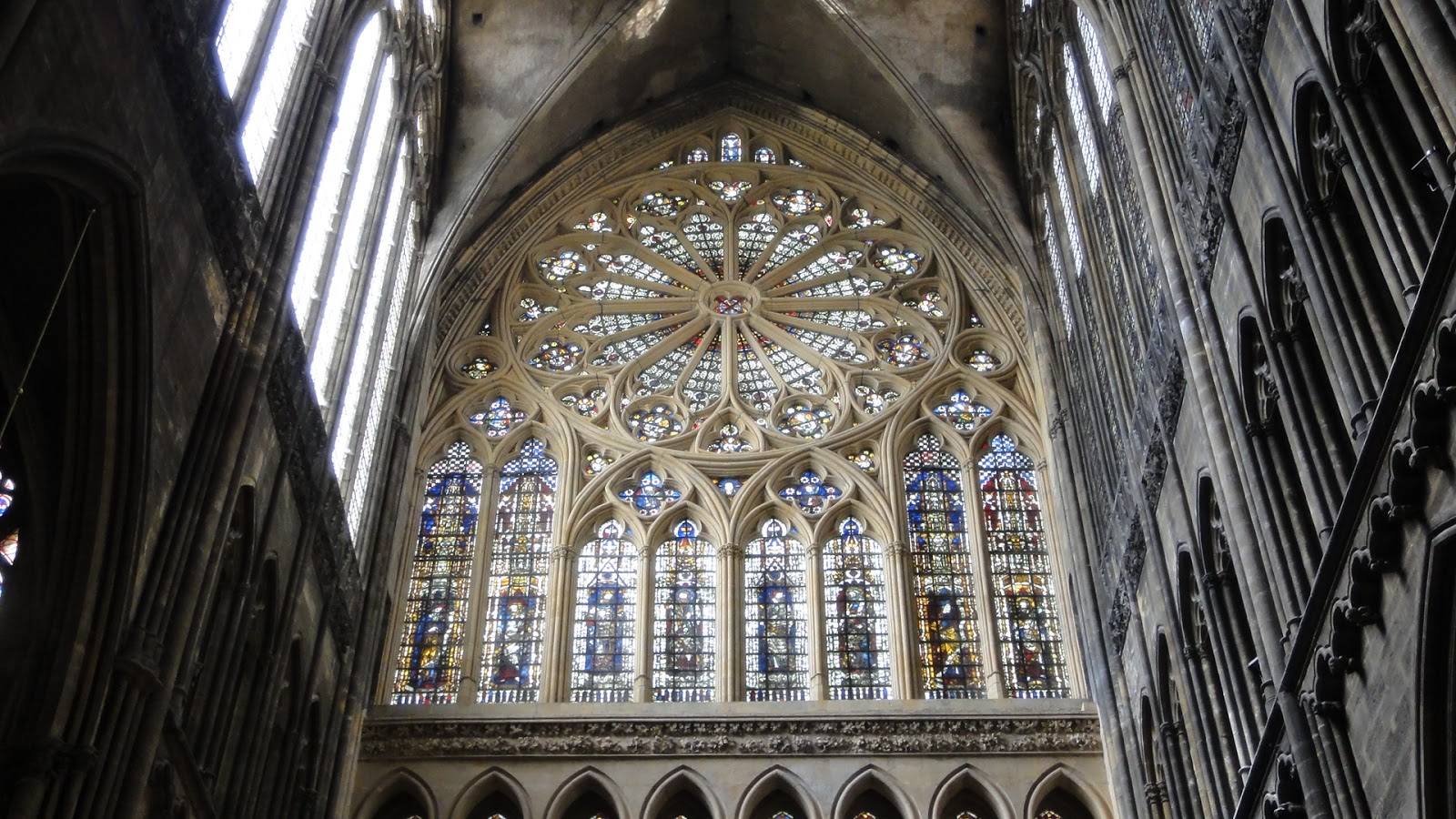
The city is most famous for its incredible Saint Etienne Cathedral, started in the 13th century and improved upon until our own time. Cleaning is currently underway. Saint Etienne has the greatest expanse of stained glass windows of any cathedral in the world, and the lighting effect is quite stunning. The front expanse which includes a vast rose window is part of the original 13th century design, and then as one ventures further toward the altar, the glass artists reflect later periods, including twentieth century artists Francois Villon (not the celebrated medieval poet) and Marc Chagall.
St Etienne Cathedral undergoing cleaning
Cathedral of light
Great rose window
Windows of Francois Villon
Window of Marc Chagall
As with the Strasbourg cathedral, Etienne has weathered the ravages of violent history, and Lorraine is no stranger to violence, having been warred over for centuries between France and Germany. Probably the worst damage, however, occurred during the French Revolution when zealot anti clerics defaced much of the church and had plans to destroy all of the windows. Fortunately, the job proved to be too expensive, so it was abandoned, and the next republic proved saner. The Jaumont stone throughout the city, including the great church, gives all of the winding streets and wide boulevards and squares a luminescence, which is only amplified exponentially in the brilliant, sun lit cathedral. Paris is called the City of Light, but certainly Metz deserves a similar appellation. Paris's lights are electric, as in so many modern cities, but Metz's are within the walls themselves, and the cathedral is a sublime window of the soul.
Museum
Tourist center
Jaumont facades
The magnificent Metz train station
Also glowing from the Jaumont bricks are the old bishop's palace, which has long served as the town's market. It is filled with fresh meat, fish, vegetables, herbs, fruit, sausages, breads and a large section of eating areas, filled with the aroma of various cooked meats. It's a riot for the senses. Further down the street is the Musee (museum) which houses a large collection of eastern French Roman artifacts, as well as important collections of more recent art from the region. Still further is a vast square across the Moselle river which is dominated by the oldest opera house in France, also of luminous Jaumont brick.
Yes, Metz has a river walk along the lazy Moselle
Shopping under the dragon, the symbol of Metz. Tradition has it that St Clement drove the dragons from Metz.
Metz is typical of many French cities, with its charming old town, filled with pedestrians and bicyclists navigating the narrow and sometimes insanely steep cobble stone streets, and the relaxed restaurants and cafes; but it is unique in its literally glowing construction and hybrid culture that, despite being clearly French, also owes plenty to German influence. Germans love to visit this town, and visitors will hear a consistent mix of both languages in the shops and patisseries. The cathedral, of course, is essential to visit when traveling through this region. There are plenty of spectacular churches in eastern France, most notably in Strasbourg and Reims, but none so luminous as Metz. Each of these great sacred spaces has it's own miraculous appeal and beauty, but the sunlit Saint Etienne is a miracle you will see nowhere else.
St Etienne's, looking up.
A smaller, but still impressive 13th century church, St Martin's, that we visited.
Last weekend we made up for our previous aborted attempt to visit Luxembourg. We finally made it! It was, admittedly, a brief trip. We left Spesbach later than we had planned (it's hard to get up early on a Saturday!), but finally took off down the road at around 10:00. We wanted to check out a small resort village in Luxembourg (the country) first. Vianden is a place of relaxation for affluent Europeans, and there are many of them in Luxembourg. The village is tucked in the hills, approached by attractive, winding country roads that, at least on that weekend, were roaring with expensive motorcycles. The village is full of rustic cafes, and most of the parking areas were full of gleaming, motorcycles. People crowded the outside tables dressed in black leather jackets. Those who weren't motorcycling, it seemed, were bicycling in bright, designer biking wear. It's a popular getaway with a long history. Victor Hugo loved the area so much that he bought a house right on the river. There is a Victor Hugo museum attached to the tourist office and a restaurant in the same building. Without at first realizing that we were on hallowed literary ground, we ate there.
Pizza and beer with the spirit of Victor Hugo
pictures of Victor Hugo's home in Vianden
Vianden, Luxembourg
I had brought 100 euro, which usually suffices for these weekend jaunts, but this restaurant took out a bite in no time. We looked at the menu, and we were about to leave; yet, we knew we had seen a pizza sign outside for 18 euro. Lawna asked the waiter, and she said "Ah, yes. Let me get the downstairs menu!" Hmm. I guess we Americans were slumming it for eating upstairs. We weren't the only ones. There was also a young French family nearby munching out on pizza. Local cuisine is fine, and I like to be adventurous, but not when it wipes out our weekend trip money. Pizza it was! And it was very good, chased down by a local Lux pilsner.
Vianden clings to a hill, weaving up steep cobble stone streets, punctuated with upscale shops and fine resorts and hotels. After we finished our meal, packing half of the pizza for later, we drove up the insanely steep main street through town to the edge of an overlook from which you can view the castle that crowns the whole area. Since we wanted to get to Luxembourg, and had already used up about half of our day, we did not attempt to visit the castle or ride the popular sky lift that takes visitors there. Maybe some other time. This excursion was a bit of a rush job.
Vianden
Vianden Castle
After taking some pictures, we headed due south to Luxembourg. It's a short drive--Luxembourg, after all, is a small country. It's also a beautiful and clean country. It's not mountainous, but it is hilly, with many winding roads and lovely villages. The city is also striking, built upon a high promontory. In fact, it is sometimes called the Gibraltar of northern Europe. In times past, this geography kept it almost invulnerable to attack and maintained centuries of peace. Like Switzerland, Luxembourg has also kept peace by managing other people's money. It is one of the major banking centers in Europe, and, yes, has been embroiled in recent global money laundering scandals. Luxembourg is also a major governing center of the EU, though Brussels is the main one. Luxembourg maintains influence by managing the union's purse strings. Thirty two miles wide and fifty one miles long, Luxembourg is one of the wealthiest countries in the world, and the city of Luxembourg is the money machine. Luxembourg has it's own language, which hardly anyone outside the country speaks, so most citizens also speak French and German, and many speak English. Luxembourg waiters can morph between these four languages effortlessly and fluently.
We arrived at the city in the late afternoon, so we parked the car in a dark, underground public garage, visited the nearby Notre Dame Cathedral, took some pictures of the city's panorama from a viewing spot on the edge of the city's precipice and then hopped on a tour bus for the quickie tour, which is guided through headphones that can dial into several different languages. Luxembourg is a rich blend of historic and modern architecture. The old city is separated into two parts by high bridges that link the two original promontories. There are also streets that wind down the cliff sides, and I developed a good bit of respect for the driver that navigated our spacious double-decker bus down the mountainside. Obviously, this modern city has outgrown it's original fortress-on-a-rock geography, and boulevards of glass banking buildings spread out beyond the old town.
Notre Dame Cathedral, Luxembourg
Notre Dame
When we completed our tour, we found a cafe downtown and ate quiche Lorraine and drank a local amber beer. A bride-to-be was walking with her best girl friends downtown, all of them decked out in frizzy pink wigs and having fun. It is a ritual that we saw in Strasbourg the week before--sort of a bachelorette party in goofy costumes. A small brass band played for a while in the town square, and then an accordianist. A good time. After an enjoyable, slow-paced meal, we strolled back to our car and started back home. In northern Europe, early summer daylight lasts until around 10:00 p.m., so we arrived home before night fell.